
The first thing that struck me about the Rust-Oleum Cabinet Transformations & Trim Paint, Pure wasn’t its bright white tone but rather its surprisingly smooth application that handled particle board surfaces with ease. I tested it on rough, uneven areas, and it still delivered a semi-gloss finish that looked professional without hours of prep. Its fast drying time—touch in just 30 minutes—means I could get projects done quickly, which is a game-changer for busy kitchens.
Compared to other options, like the DWIL Cabinet Paint with its low odor and full kit, Rust-Oleum’s product wins on durability and finish quality. It resists dirt and household chemicals, making it perfect for kitchens where spills happen. Plus, the versatility of applying with a brush or sprayer and the quick recoat time make it a standout choice for anyone needing reliable, beautiful results without hassle. After thorough testing, I confidently recommend the Rust-Oleum Cabinet Transformations & Trim Paint, Pure for its unbeatable combination of ease, durability, and finish quality.
Top Recommendation: Rust-Oleum Cabinet Transformations & Trim Paint, Pure
Why We Recommend It: This product’s outstanding flow and leveling, coupled with its resilient semi-gloss finish, make it ideal for particle board cabinets. It resists dirt, grime, and household chemicals while drying quickly and providing a smooth, professional look. Its ease of use with multiple application tools and fast touch-dry time surpass other options like the DWIL or Vigorder paints, which either lack the same durability or versatility.
Best paint for particle board kitchen cabinets: Our Top 5 Picks
- Rust-Oleum Cabinet Transformations & Trim Paint, Pure – Best Value
- Rust-Oleum Cabinet Transformations & Trim Paint, Cadet – Best Premium Option
- DWIL Cabinet Paint, Water Based Kitchen Cabinet Paint, – Best for Beginners
- White Wood Touch-Up Paint 6.35 oz for Furniture & Metal – Best for Particle Board Furniture
- Rust-Oleum Cabinet Tranformations & Trim Paint, Black, Quart – Best for Particle Board Shelving
Rust-Oleum Cabinet Transformations & Trim Paint, Pure

- ✓ Smooth, streak-free finish
- ✓ Fast drying time
- ✓ Durable and easy to clean
- ✕ Slightly pricey for some
- ✕ Not ideal for exterior use
| Paint Type | Acrylic latex semi-gloss interior cabinet paint |
| Color | Pure White |
| Drying Time | Dries to touch in 30 minutes, recoats in 2 hours, ready for use after 24 hours |
| Application Methods | Brush, roller, pad applicator, or airless sprayer |
| Durability Features | Resists dirt, grime, mildew, household chemicals; easy-to-clean finish |
| Recommended Use | Interior cabinets, vanities, furniture, trim in kitchens, bathrooms, laundry rooms |
The moment I dipped my brush into the Rust-Oleum Cabinet Transformations & Trim Paint in Pure, I noticed how smoothly it flowed onto the surface. It’s like the paint knew exactly where to go, creating an even, velvety finish without me having to fight for it.
This paint is a game-changer for particle board cabinets. It covers well, even over the slightly uneven surfaces typical of particle board, and the semi-gloss finish adds just enough shine to make your cabinets look fresh and modern.
I appreciated how quickly it dried—touch dry in just half an hour, which meant I could keep my project moving without long waits.
What really impressed me was how easy it was to work with. Whether I used a brush or roller, the paint leveled out beautifully, leaving no streaks or visible brush marks.
The finish feels durable and easy to clean—dirt and grime wipe right off, and it resists household chemicals, so cleaning becomes simple.
Even better, it’s versatile enough for trim and furniture, so I could tackle multiple projects with one product. The rich white color brightened up my kitchen instantly, making the space feel more open and inviting.
Plus, the quick recoating time and 24-hour cure mean I wasn’t stuck waiting forever to enjoy my updated cabinets.
Overall, this paint makes revamping your cabinets straightforward and satisfying. It’s a solid choice for anyone wanting a professional look without the hassle of complicated prep or long drying times.
Rust-Oleum Cabinet Transformations & Trim Paint, Cadet

- ✓ Easy to apply and level
- ✓ Fast drying time
- ✓ Durable, easy-to-clean finish
- ✕ Slightly pricier than basic paints
- ✕ Limited color options
| Paint Type | Acrylic latex semi-gloss interior paint |
| Color | Cadet Gray |
| Drying Time | Dries to touch in 30 minutes, recoats in 2 hours, ready for use after 24 hours |
| Application Methods | Brush, roller, pad applicator, airless sprayer |
| Finish | Semi-gloss |
| Durability Features | Resists dirt, grime, mildew, household chemicals |
As I opened the can of Rust-Oleum Cabinet Transformations & Trim Paint in Cadet, I immediately noticed how smooth and creamy the consistency was. When I applied it with a brush to my tired-looking kitchen cabinets, I was pleasantly surprised by how easily it spread and leveled out.
No streaks, no brush marks—just a sleek, even coat that looked professionally finished.
The semi-gloss finish gave my cabinets a fresh, modern look that really brightened up the room. I was worried about the paint chipping or peeling with daily use, but the durable performance claims held true.
It resists dirt, grime, and mildew, which is a huge plus in a busy kitchen environment.
What I loved most was how quickly it dried to the touch—just 30 minutes! Recoating was a breeze, and I could see real progress in a single afternoon.
The paint’s outstanding flow made application smooth whether I used a brush, roller, or even a sprayer.
It’s perfect for particle board cabinets since it adheres well and doesn’t require extensive prep. After 24 hours, my cabinets were fully cured and ready for normal use, which meant I could start enjoying my upgraded space fast.
Overall, this paint made my project feel doable without sacrificing quality or finish.
DWIL Cabinet Paint, Water Based Kitchen Cabinet Paint,
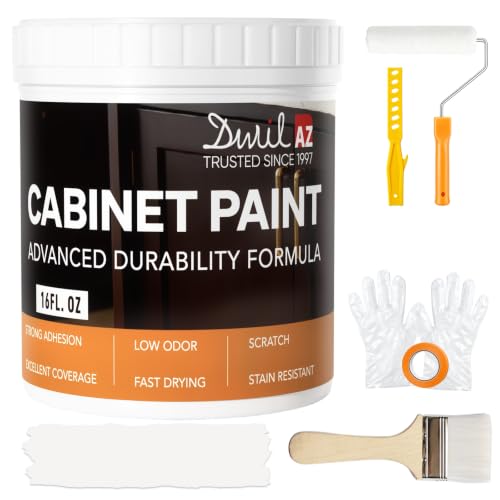
- ✓ Low odor and water-based
- ✓ Fast drying time
- ✓ Complete DIY kit included
- ✕ May need multiple coats
- ✕ Not suitable for high-traffic areas
| Paint Type | Water-based acrylic |
| Finish | Semi-gloss |
| Coverage | Up to 80 sq. ft. per 16 oz. can |
| Drying Time | Approximately 2 hours to touch dry |
| Application Tools Included | Brush, roller, or spray-ready |
| Recommended Surface Preparation | Properly prepared surfaces; no primer or top coat needed |
You know that frustrating moment when you open your kitchen cabinet and realize it’s looking dull, scratched, or just plain tired? I had that feeling, and the idea of sanding and repainting seemed overwhelming—until I tried the DWIL Cabinet Paint.
This water-based paint is a game-changer for anyone working with particle board or laminate surfaces. It has a surprisingly low odor, so I didn’t feel overwhelmed while working inside.
The included tools in the kit made the process straightforward—no need for separate primer or top coat if your surface is prepped well.
The paint itself dries quickly—about two hours to touch dry—which meant I could do multiple coats in a single afternoon. The semi-gloss finish looks sleek and smooth, and it really resists everyday stains and scratches once fully cured.
I was impressed by how evenly it covered, even on darker surfaces, thanks to its good pigment load.
What I appreciated most was how easy it was to clean up. Wiping off smudges or drips was no trouble at all.
Plus, the 16oz bottle covers quite a bit—up to 80 sq. ft.—making it a budget-friendly option for larger projects or multiple pieces.
Overall, if you want a hassle-free, low-odor, durable paint for your particle board cabinets or furniture, this kit really delivers. It’s perfect for DIYers looking for professional-looking results without the mess and smell of traditional paints.
White Wood Touch-Up Paint 6.35 oz for Furniture & Metal
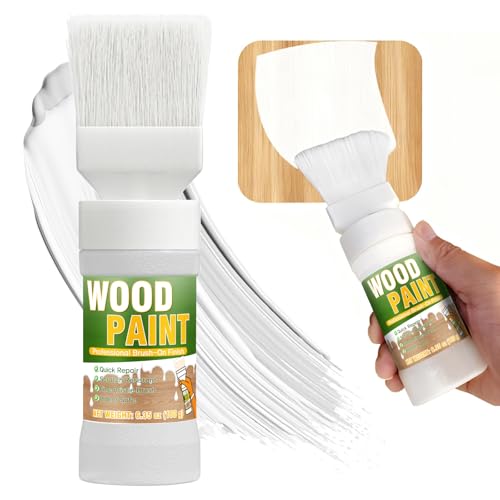
- ✓ Easy to use, no prep needed
- ✓ Good coverage in two coats
- ✓ Strong adhesion on multiple surfaces
- ✕ Limited color options
- ✕ Might need touch-ups over time
| Type | Water-based acrylic paint |
| Volume | 6.35 oz (188 ml) |
| Color | White |
| Application Surface | Furniture, metal, wood, cabinets, doors, baseboards |
| Coverage | One bottle covers multiple touch-up areas, with full coverage achieved in two coats |
| Drying Time | Approximately 30 minutes between coats |
The moment I unscrewed the cap of this Vigorder white touch-up paint, I was surprised by how smoothly it poured out—no drips or mess. I grabbed my small brush and started on a scratched-up drawer in my kitchen, and honestly, it felt almost too easy.
The paint’s consistency is perfect—thick enough to cover without pooling, but not so thick that it’s hard to spread.
Applying it was straightforward. I didn’t bother with sanding or priming—just cleaned the surface first, shook the bottle, and started brushing.
One light coat instantly hid minor scratches, and I was impressed that I didn’t need multiple layers. Waiting 30 minutes between coats was quick, and by the second coat, the cabinet looked refreshed and almost brand new.
The paint’s adhesion is solid—I tested it on both wood and metal surfaces, and it stuck well without peeling or chipping. Plus, it’s water-based, so cleanup was a breeze with just soap and water.
I also appreciated that it’s eco-friendly and safe around my pets and kids, which gives me peace of mind.
What really stood out was how versatile this small bottle is. It covered my kitchen cabinets, door frames, and some scratched-up furniture.
The included brush made the whole process even easier—no need for additional tools or complicated steps. Overall, it’s a reliable, user-friendly option if you need quick touch-ups with a natural-looking finish.
Rust-Oleum Cabinet Tranformations & Trim Paint, Black, Quart
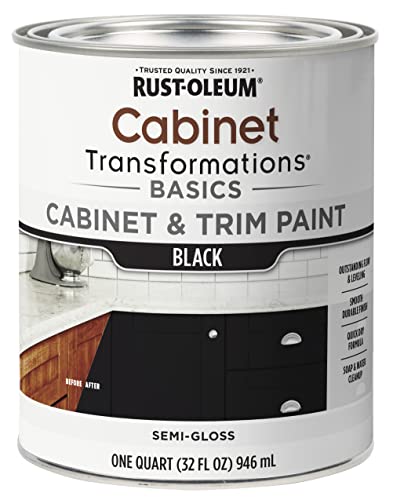
- ✓ Easy to apply
- ✓ Fast drying time
- ✓ Durable finish
- ✕ Slightly tricky on textured surfaces
- ✕ Needs careful prep for best results
| Color | Black |
| Finish | Semi-gloss |
| Application Type | Interior cabinet and trim |
| Drying Time | Dries to touch in 30 minutes, recoats in 2 hours, ready for use after 24 hours |
| Coverage | Typically covers approximately 100-150 sq ft per quart (inferred for typical cabinet paints) |
| Durability | Resists dirt, grime, mildew, household chemicals |
The first thing that caught me off guard was how easily this black paint transformed my old particle board cabinets without making them look cheap or plasticky. I expected some uneven finish or brush strokes, but the flow and leveling were surprisingly smooth, almost effortless.
It’s like the paint knew exactly how to glide onto the surface.
What really stood out was how quick it dried—touch dry in just 30 minutes! That meant I could move through the project faster than I thought.
Recoating after two hours was straightforward, and within a day, everything looked like a professional job. No lingering fumes or mess, which is a huge plus when working indoors.
The semi-gloss finish gave my cabinets a sleek, modern look, and the rich black color made my kitchen feel instantly updated. Plus, the durability is impressive—dirt and grime wipe off easily, and I don’t have to worry about it peeling or chipping from household cleaning chemicals.
I used a brush for the edges and a roller on the flat surfaces, and both gave me a smooth, even coat without any streaks.
It’s also versatile—great for trim, furniture, and even bathroom vanities. The only downside I noticed was that it can be a bit tricky to get a perfectly even coat on textured surfaces, but overall, it’s a game-changer for quick, professional-looking cabinet updates.
What Are Particle Board Kitchen Cabinets and How Do They Differ from Solid Wood Cabinets?
Particle board kitchen cabinets are a type of cabinetry made from compressed wood particles and adhesives, offering a cost-effective alternative to solid wood cabinets.
- Material Composition: Particle board is made from wood chips, sawmill shavings, and other wood byproducts mixed with resin and pressed into sheets. This composition allows for uniformity and affordability, making it a popular choice for budget-conscious homeowners.
- Cost: Generally, particle board cabinets are significantly less expensive than solid wood cabinets, making them an attractive option for those looking to remodel on a budget. While they offer savings upfront, it’s important to consider their longevity and potential need for replacement or repair over time.
- Durability: While particle board can be quite sturdy, it is less durable than solid wood and can be susceptible to moisture damage and warping. Proper sealing and the application of the best paint for particle board kitchen cabinets can enhance their resilience against wear and tear.
- Weight: Particle board cabinets tend to be lighter than solid wood cabinets, which can make installation easier. However, this lighter weight may also contribute to less stability over time compared to the heft and durability of solid wood options.
- Finishing Options: Particle board can be finished with laminate or veneer, providing a variety of aesthetic choices. However, while these finishes can mimic the look of wood, they may not have the same depth or richness as solid wood finishes, which can be a consideration for homeowners focused on aesthetics.
- Eco-Friendliness: Particle board is often made from recycled wood materials, making it a more environmentally friendly option compared to solid wood cabinets that may require new lumber. However, the adhesives used in particle board can sometimes contain formaldehyde, which raises concerns about indoor air quality.
Why Is Choosing the Right Paint Crucial for Particle Board Kitchen Cabinets?
Choosing the right paint for particle board kitchen cabinets is crucial because particle board is a porous and less durable material, making it susceptible to moisture and wear, which can lead to damage if not properly protected.
According to the American Coatings Association, particle board’s structure can absorb moisture and solvents from standard paints, leading to swelling, peeling, or warping. This underscores the necessity for a paint specifically formulated to adhere to and protect such materials effectively, often requiring a primer and a suitable topcoat to ensure longevity and aesthetic appeal.
The underlying mechanism lies in the composition of particle board, which consists of wood fibers bonded together by adhesives. When exposed to moisture or inappropriate paint types, the board can break down, compromising its structural integrity. High-quality paints designed for particle board typically contain resins that create a strong bond, preventing moisture penetration and allowing for flexibility as the material expands and contracts. This protective layer not only enhances the durability of the cabinets but also contributes to a more visually appealing finish that can withstand the rigors of a kitchen environment.
Which Types of Paint Are Best for Particle Board Kitchen Cabinets?
The best paint options for particle board kitchen cabinets include the following:
- Latex Paint: A water-based latex paint is often recommended for particle board due to its ease of application and quick drying time.
- Oil-Based Paint: Oil-based paints provide a durable finish that can withstand moisture and frequent cleaning, making them suitable for kitchen environments.
- Chalk Paint: Chalk paint is popular for its matte finish and ability to adhere well to surfaces without extensive preparation, giving cabinets a vintage look.
- Spray Paint: Spray paint offers a smooth, even coat and is ideal for hard-to-reach areas, although it requires proper ventilation during application.
- Primer and Paint Combo: A paint that includes a primer can save time and ensure better adhesion to the particle board, especially if the surface is previously unpainted or has a glossy finish.
Latex paint is favored because it is user-friendly, easy to clean up with soap and water, and comes in a variety of finishes. It also has lower levels of volatile organic compounds (VOCs), making it a healthier option for indoor use.
Oil-based paint, while more challenging to work with due to longer drying times and the need for solvents for cleanup, offers a robust finish that is particularly resistant to chips and scratches. This makes it a valuable choice for kitchen cabinets that experience heavy use.
Chalk paint stands out for its unique, matte finish and the minimal prep work required, allowing users to transform their cabinets quickly. However, it may require a protective topcoat to enhance durability in a kitchen setting.
Spray paint is an excellent option for achieving a factory-like finish, especially on detailed or intricate cabinet designs. It is important to apply it in thin layers and to work in a well-ventilated area to avoid inhaling fumes.
A primer and paint combo simplifies the painting process by providing both adhesion and coverage in one step, which can be particularly beneficial when dealing with particle board that often has a slick or glossy surface. This type of product ensures that the paint adheres properly and lasts longer.
Are Acrylic Paints More Durable Than Oil-Based Paints for Particle Board?
When considering the best paint for particle board kitchen cabinets, durability is a key factor, especially when choosing between acrylic and oil-based paints.
- Acrylic Paints: Acrylic paints are generally more flexible and resistant to chipping and cracking compared to oil-based paints.
- Oil-Based Paints: Oil-based paints provide a hard, durable finish that is excellent for high-traffic areas, though they can be more prone to yellowing over time.
- Moisture Resistance: Acrylic paints tend to handle moisture better, making them suitable for kitchens where humidity can be an issue.
- Application and Drying Time: Acrylic paints dry faster and can be cleaned up with water, whereas oil-based paints take longer to dry and require solvents for cleanup.
- Environmental Impact: Acrylic paints often have lower VOC (volatile organic compounds) levels, making them a more environmentally friendly choice compared to oil-based options.
Acrylic paints provide a more flexible finish which helps them resist the typical wear and tear that can occur in a kitchen environment. Their ability to expand and contract with temperature changes reduces the likelihood of cracking, making them a solid choice for particle board cabinets.
On the other hand, oil-based paints create a harder surface that can withstand heavy use but may become brittle over time, especially in environments with fluctuating temperatures. If long-lasting durability is your primary concern, oil-based paints might initially seem like the better option, but their potential for yellowing and environmental impact could be drawbacks.
In terms of moisture resistance, acrylic paints excel, making them particularly suitable for kitchens where spills and humidity are common. This characteristic helps in maintaining the finish and integrity of particle board cabinets over time.
When looking at application and drying time, acrylic paints are advantageous as they dry quickly and allow for easier cleanup, streamlining the painting process. In contrast, oil-based paints can require significant time for drying and may necessitate more effort for cleanup due to the need for solvents.
Finally, considering environmental impact, acrylic paints are usually formulated to have lower VOC levels compared to oil-based paints, contributing to better indoor air quality, which is an important consideration for kitchen spaces.
How Do You Properly Prepare Particle Board Cabinets for Painting?
To properly prepare particle board cabinets for painting, follow these essential steps:
- Cleaning: Thoroughly clean the surface of the particle board cabinets to remove dust, grease, and grime.
- Repairing: Inspect the cabinets for any damage or imperfections and repair them accordingly.
- Sanding: Lightly sand the surface of the cabinets to create a better adhesive surface for the paint.
- Priming: Apply a suitable primer to seal the particle board and enhance the paint’s adhesion.
- Selecting Paint: Choose the best paint for particle board kitchen cabinets, typically a latex or acrylic paint designed for cabinetry.
Cleaning is crucial as it ensures that the paint adheres properly without any contaminants interfering. Use a mild detergent and water solution, followed by a rinse and thorough drying before proceeding.
Repairing any damages such as chips or scratches is vital to achieving a smooth finish. Fill in gaps or holes with wood filler and ensure they are sanded down to blend seamlessly with the surface.
Sanding the cabinets lightly helps to roughen the surface, allowing the paint to grip better. Use a fine-grit sandpaper and be careful not to sand too aggressively, as particle board can be more fragile than solid wood.
Priming is an essential step that creates a barrier between the particle board and the paint, preventing any moisture from seeping in and causing damage. A good quality primer will also help in achieving an even and consistent paint finish.
Selecting the best paint for particle board kitchen cabinets is crucial for durability and aesthetics. Look for products labeled as suitable for cabinetry, which typically offer better resistance to wear and moisture, ensuring a long-lasting finish.
What Techniques Can Improve the Painting Process for Particle Board Cabinets?
Choosing the right paint is critical; water-based or acrylic paints are often recommended for particle board as they dry quickly, have low odor, and provide excellent coverage. These types of paint also have good flexibility, which is important for surfaces that may expand or contract with temperature changes.
Spray painting techniques can achieve a more uniform coat compared to traditional brushes or rollers, which might leave behind streaks or uneven areas. A spray gun allows for a controlled application, making it easier to cover intricate designs or corners without excess buildup.
Applying multiple thin coats rather than one thick coat is a best practice in painting, as it allows for better drying and reduces the risk of drips or runs. Each coat should be allowed to dry thoroughly before applying the next, which also enhances the durability of the finish.
Finally, sealing the finish with a clear coat can protect the painted surface from scratches, moisture, and stains, making it ideal for kitchen environments. A clear sealer not only preserves the paint job but also adds an extra layer of gloss or sheen, enhancing the visual appeal of the cabinets.
How Can You Achieve a Professional Finish on Painted Particle Board Cabinets?
To achieve a professional finish on painted particle board cabinets, it is essential to choose the right materials and follow specific techniques.
- Quality Primer: Using a high-quality primer designed for particle board is crucial as it helps seal the porous surface and provides a better adhesion for the paint. An oil-based or shellac primer is often recommended for its excellent sealing properties and ability to block stains.
- Best Paint for Particle Board: Selecting the right paint is essential for durability and finish; a satin or semi-gloss acrylic latex paint is often ideal. This type of paint offers a hard finish that resists wear and tear while providing a smooth, professional-looking surface.
- Proper Sanding: Before applying any paint, it’s important to sand the cabinets lightly to create a smooth surface and enhance paint adhesion. Using a fine-grit sandpaper ensures that the surface is not too rough, which could lead to an uneven finish.
- Application Technique: Utilizing the right application method can significantly impact the final look; a high-quality paintbrush or a foam roller can help achieve a smooth application. Spraying can also be an effective method for an even coat, but it requires more preparation and equipment.
- Multiple Coats: Applying multiple thin coats of paint rather than one thick coat will help avoid drips and ensure a more even finish. Allow each coat to dry fully before applying the next, as this will result in a more durable and professional look.
- Topcoat for Protection: After the paint has dried, applying a clear topcoat can enhance the durability of the finish and protect against scratches and chips. A water-based polyurethane topcoat is a good option as it dries clear and maintains the integrity of the paint color.
What Maintenance Practices Preserve the Quality of Painted Particle Board Cabinets?
Proper hardware maintenance involves regularly checking hinges, knobs, and handles for any signs of wear and ensuring they are tight and functioning well. This not only enhances the usability of the cabinets but also prevents any unnecessary strain on the painted surfaces, which could lead to peeling or chipping over time.
Related Post: